
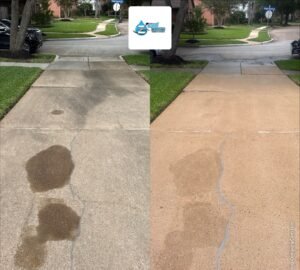
Most concrete stains aren’t a surface problem; they’re a chemistry problem. If you’re dealing with a dark oil patch or an orange rust streak on your driveway, the fix depends entirely on what the stain is made of, not how hard you scrub it. And concrete cleaning in Houston can be your answer to all these problems.
Why Houston Concrete Stains Faster Than You’d Expect
Houston’s humidity averages above 90% in peak summer. That changes everything.
Concrete is porous. In dry climates, surface moisture evaporates quickly and takes some contaminants with it. In Houston, high humidity slows that evaporation down and instead of lifting out, oil and rust get pushed deeper into the slab.
This plays out visibly in neighborhoods like Pearland and Katy, where flat driveways with poor drainage sit in standing moisture for hours after rain. A stain that might stay surface-level in Dallas becomes a deep-pore problem here.
Most guides tell you to act fast. That’s true; but acting fast with the wrong product in Houston’s humidity can seal the stain in further. That’s why what matters more than when.
Oil Stains on Concrete: What’s Actually Happening Below the Surface?
Why Pressure Washing Alone Won’t Remove an Oil Stain
Oil doesn’t just sit on top of concrete. It bonds with the limestone matrix inside the slab at a molecular level.
Pressure washing breaks that bond? No. It redistributes the oil laterally, spreading the stain wider while making it look temporarily cleaner. That’s why a power-washed driveway often looks fine when wet and shows the stain again once it dries.
Professional-grade degreasers work differently. They break the hydrocarbon-to-limestone bond and pull oil upward through capillary action, a process called poultice extraction. Combined with hot water (200°F+), the treatment lifts oil from deep inside the slab rather than pushing it around.
Cold water doesn’t work for Houston oil stains. The heat is what mobilizes the grease. A minute detail others won’t tell you.
What Happens If You Leave an Oil Stain Untreated?
UV exposure and Texas heat bake oil deeper over time. As it penetrates further, it begins breaking down the concrete’s surface layer, a process called spalling, where the top layer starts to flake and pit.
What starts as a cosmetic stain becomes a structural issue. The longer it sits, the more expensive the fix.
Rust on Concrete: Why the Wrong Cleaner Makes It Permanent?
The Acid Trap: What Big-Box Rust Removers Do to Your Slab
Walk into any hardware store and the rust removers on the shelf are almost all acid-based. On metal, they work fine. On concrete, they cause serious damage.
Acid doesn’t just lift rust, it etches the concrete’s cream finish. The result is a permanent bleached or white patch that’s often more visible than the original rust stain. You haven’t fixed the problem; you’ve traded one stain for another that can’t be reversed.
Rust is iron oxide. To remove it from concrete safely, you need a pH-balanced rust converter not an acid. The converter transforms the iron oxide into a stable compound that lifts off without attacking the concrete surface underneath.
The Right Chemistry: pH-Balanced Rust Neutralization
pH-balanced converters do something acid cleaners can’t: they remove the rust without touching the concrete’s finish.
The result is clean and uniform, not patchy or bleached. This is the professional standard and it’s why two driveways treated for rust can look completely different depending on which product was used.
If you’ve tried a retail rust remover and been left with discoloration, acid etching is likely the cause.
DIY Pressure Wash vs. Professional Concrete Restoration: A Side-by-Side Look
For homeowners weighing the cost of Houston concrete cleaning services against doing it themselves, here’s what the comparison actually looks like in practice:
| Feature | DIY Pressure Wash | Professional Restoration |
| Water Temp | Cold (tap water) | Hot water (200°F+) |
| Chemicals | Harsh, non-targeted acids | Biodegradable, EPA-certified agents |
| Finish Consistency | Zebra stripes, uneven patches | Uniform, streak-free surface |
| Oil Stain Result | Surface rinse; stain remains | Deep-pore extraction and lift |
| Rust Stain Result | Often leaves bleach spots | pH-balanced neutralization |
| Concrete Safety | Risk of pitting or joint damage | Pressure matched to slab condition |
The gap isn’t just about equipment. It’s about knowing which chemistry to apply to which stain and adjusting the approach based on the age and condition of the slab.
The Surface Cleaner Advantage: Why Professional Equipment Changes the Result
One of the most common signs of DIY pressure washing is the zebra stripe alternating dark and light bands across a driveway where a wand passed unevenly.
Professional technicians use rotary surface cleaners (sometimes called whirl-a-way tools). These spin water in a 360-degree pattern at controlled pressure, delivering uniform coverage across the entire surface.
More importantly, they match pressure to the slab. A 15-year-old driveway in Fresno needs different treatment than a freshly poured patio in Sugar Land. High pressure on older concrete can blow out expansion joints or crack the slab itself ; damage that no amount of cleaning will fix afterward.
For a deeper look at maintaining your driveway between professional cleanings, Concrete Cleaning Tips: How to Restore Dirty Driveways covers the practical steps homeowners can take on their own.
What Responsible Concrete Cleaning Looks Like in Houston
Professional concrete cleaning involves more than removing the stain. Two things often get overlooked:
- Runoff management: Wash-water carrying oil, rust particles, and cleaning agents flows directly into Houston’s storm drains and bayous if not properly contained. Under TCEQ (Texas Commission on Environmental Quality) guidelines, professional operators are required to manage this. Most DIY washes skip this step entirely — which means the contaminants end up in the local water system.
- Clean before you seal: Sealing concrete over an untreated oil or rust stain traps the contaminant beneath the surface. Over time, it accelerates spalling from underneath. A proper deep clean is the preparation for sealing — the two work as a system, not as separate, optional steps.
When Is It Time to Call a Professional for Concrete Cleaning in Houston?
DIY pressure washing handles fresh surface dirt well. But there are clear signs it’s hit its limit:
- The stain is more than 2–3 months old
- Previous cleaning attempts left discoloration or bleach patches
- Oil and rust stains are both present on the same surface
- The concrete is older and showing early signs of pitting or surface wear
At that point, the chemistry and equipment required go beyond what a rented pressure washer can deliver. Zeal Power Washing offers next-day service across Houston and surrounding areas, no hard sell, just a free estimate and an honest look at what the surface needs.
Frequently Asked Questions About Concrete Cleaning in Houston
How Much Does It Cost to Get Concrete Cleaned in Houston?
Professional concrete cleaning in Houston typically runs between $0.15 and $0.35 per square foot, depending on stain type, slab size, and condition. A standard two-car driveway generally falls in the $150–$250 range. Pricing for driveway cleaning in Houston varies by company, so getting two or three quotes is always worthwhile.
What Do Professionals Use to Clean Concrete Effectively?
Professionals combine hot-water pressure units, biodegradable degreasers, pH-balanced rust converters, and rotary surface cleaners. The key difference from DIY is that each product is matched to the specific stain type; there’s no single “concrete cleaner” that handles everything well.
What Should You Never Use to Clean Concrete?
Avoid muriatic acid, undiluted bleach on colored or stamped concrete, and high-pressure wands on older slabs. All three cause permanent damage — acid and bleach etch the surface finish, while excess pressure cracks the slab or destroys expansion joints.
What Is the Biggest Long-Term Enemy of Concrete?
Moisture infiltration combined with untreated organic or chemical contamination is what degrades concrete fastest. In Houston’s climate, humidity keeps the surface damp, which accelerates the breakdown when oil, rust, or algae are left untreated. Spalling, cracking, and surface flaking follow.
How Do Professionals Clean Concrete Without Damaging It?
They match water pressure to slab age and condition, use surface cleaners for even coverage, and rely on dwell-time chemistry rather than brute force. The goal is to let the cleaning agents do the work, not the pressure. This protects the concrete’s finish and structural integrity throughout the process.

Trey is the owner of Zeal Power Washing, a Houston-based exterior cleaning company specializing in residential and commercial services. With over 8 years of experience, he focuses on pressure washing, concrete cleaning, window cleaning, and surface restoration.
He is committed to delivering reliable, high-quality results while helping property owners maintain and protect their investments.